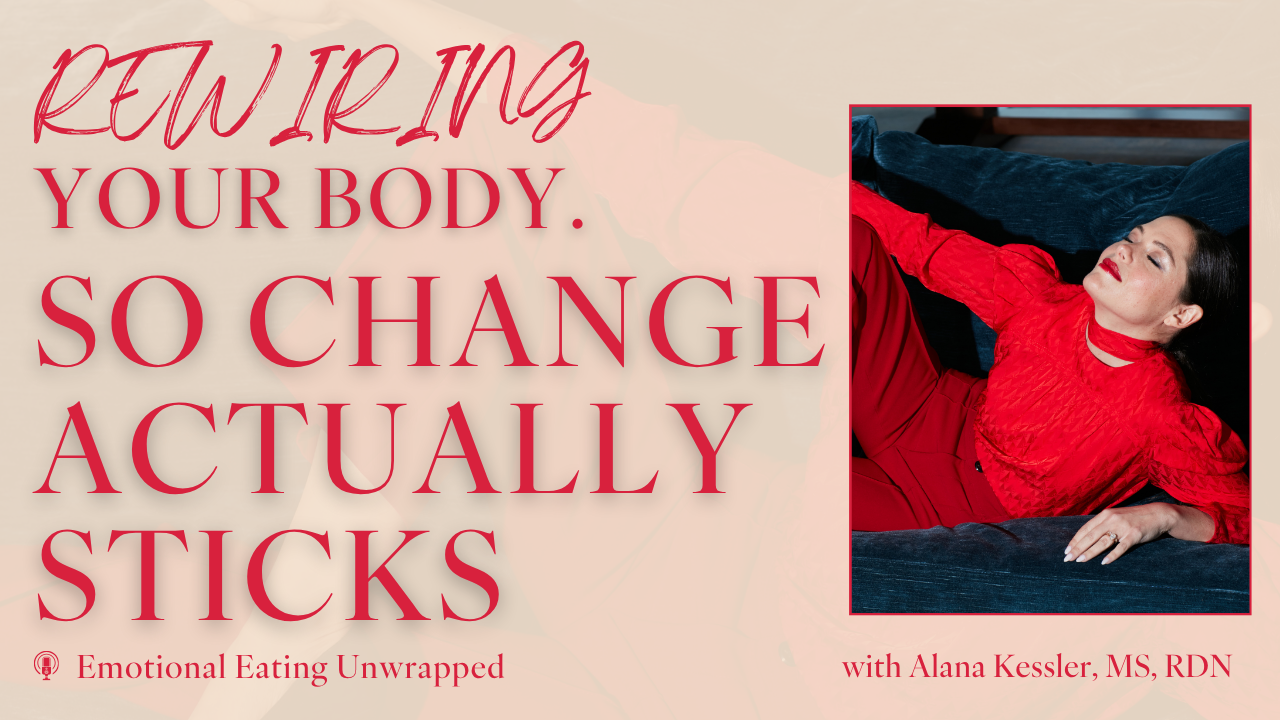
Emotional Eating Unwrapped (Sober Eating Podcast): EP 111
You can explain exactly why you overeat: the stress, the loneliness, the conflict that set it off. And still the pattern repeats, and the knowing starts to feel like proof that something is wrong with you. This episode explains why insight stalls and how mentorship that turns insight into lived change works differently.
Alana Kessler, MS, RDN, CDN, a registered functional dietitian, describes awareness as a light switch: it shows you the room, "but it doesn't move the furniture." She walks through what actually moves you from understanding to integration.
Takeaways
⦿ Awareness is the light switch; it doesn't move the furniture.
⦿ You can't think your way into safety; your body must feel safe.
⦿ Naming triggers isn't healing; staying with them is.
⦿ Self-awareness without integration fuels self-criticism and shame.
⦿ Your higher self doesn't narrate; she guides.
Why doesn't knowing your triggers stop emotional eating?
Alana hears it often: women who can recall every detail of why they binge, yet still do it. Intellectual awareness, she explains, does not reach the nervous system. If you have never felt safe sitting with loneliness, naming it will not stop the reach for comfort when the feeling floods in. One client could list her triggers like a checklist, and in the moment she still just wanted relief. Research on how emotions and eating connect in daily life points the same way: questionnaire scores for emotional eating often do not predict what people actually eat.
"Because you don't heal by knowing your patterns. You don't heal by knowing your triggers." (Alana, 11:37)
The body, she says, changes through sensation: a tight chest, racing thoughts, restless hands.
How do you move from awareness to integration?
Awareness without integration can turn into shame, Alana warns, because the more you understand your patterns, the more you expect yourself to be past them. Integration means staying with the feeling long enough to try a new response. If you overeat when you feel unappreciated, it looks like expressing what you need. If you restrict to feel in control, it looks like regulating uncertainty without food rules. Your higher self, she says, acts as a guide in the moment rather than a narrator.
"I see you reaching for food. Let's take a breath." (Alana, 20:50)
If restriction and bingeing feed each other for you, support for the binge and restrict pattern is one place to start, and this piece on why capable, successful women overeat explores the same gap.
Key moments in this episode
Click a time to play the video from that moment.
0:27 Why awareness alone does not change your life
1:32 Awareness as a light switch
3:22 Knowing exactly why you binge
5:03 Awareness without embodiment as a bypass
9:28 A client who could name every trigger
11:58 When self-awareness turns into shame
14:41 Integration examples for overeating and restriction
20:50 What your higher self says in the moment
Read the transcript
Full episode transcript
Clean verbatim transcript of this episode: filler words and false starts removed, nothing reworded. Click a time to play the video from that moment.
Introduction
0:07 Welcome to the Emotional Eating Unwrapped podcast. I'm your host, Alana Kessler, an emotional eating and weight loss coach for women looking to fall in love with eating, create healthy attachments with food, and lose weight sustainably.
0:27 Hello and welcome to another new episode of Emotional Eating Unwrapped. I'm your host, Alana Kessler, and today we're going to talk about something that doesn't get said enough in the healing space. We're going to be talking about how awareness, right, awareness, self-awareness by itself, it does not change your life. Okay? And I know this can be controversial because so much of personal growth focuses on becoming more self-aware. And I actually believe that self-awareness is such an important part of personal growth and of healing. But here's the truth about self-awareness.
1:13 You can understand something. You can understand why you overeat. You can understand why you self-sabotage. You can understand why you lose trust with your body and still be stuck in the same patterns. Because awareness, what awareness really is, is it's a light switch. It helps you see the room that you're in, but it doesn't move the furniture around the room. Okay? Awareness actually takes you from dark to light, but it doesn't move things around. Doesn't change the context, doesn't change the infrastructure.
1:55 And that's where a lot of women get trapped. Especially the ones who are intelligent, especially the ones who are high achieving, introspective, because you have done the work. You have spent time and effort and energy understanding. You probably see your patterns really clearly, but they keep repeating. So today I want to talk about why awareness alone can actually keep you stuck and what actually moves you forward. Okay. So let's get into it.
2:40 Awareness. Okay. Awareness. It feels good. I love an aha moment. Love. I think that feeling of clarity. Something that you didn't quite understand or that felt resistant inside you, confused, and then you just get clear and there's awareness and that feels amazing. It gives us control. It gives us language. But sometimes awareness becomes a way of staying in your head. It becomes a way of analyzing instead of feeling.
3:22 And that's something that I was definitely a victim of, of living in my head, of being so smart, the ability to describe something, but not really be able to feel it, not be able to have that awareness translate into change. I can't tell you how many women have said to me, "I know exactly why I binge." They can recall to me an entire situation. They could tell me why they binge, right? They're like, "I'm stressed. I was lonely. I just had a huge show that I performed in, and I went from being really high to being really low, but I still did it," right? Like, all the time I hear this.
4:04 And that's because intellectual awareness, it doesn't reach the nervous system. It doesn't rewire the body and the patterned belief systems, right? It keeps you observing. It keeps you observing your behavior instead of experiencing what's underneath it. Okay, that's really important to hear. Okay, intellectual awareness keeps you observing in your head instead of experiencing what's underneath, which means that you're feeling the experience in your body. So, think of it like this. Awareness is like looking at the locked door. And embodiment is finding the key. It's finding the key and being able to walk through the door.
5:03 So awareness without embodiment, right? Understanding without experiencing the feeling sense underneath is a bypass. Okay? Some people call it a spiritual bypass, but ultimately it becomes emotional avoidance wrapped in self-reflection, which on the outside can seem really evolved, and it can make it seem to other people and sometimes even to our own selves that we're moving the needle forward towards our healing. But this is why we have to be radically honest with ourselves and be willing to recognize within ourselves, and this is a self-leadership part we're going to go into later, but within ourselves when we are believing our own intelligence as healing, knowing that it's really keeping us stuck.
The gap between knowing and feeling safe
8:07 Let's be really honest. There's often a really huge emotional gap between what you know in your brain and what you feel safe to act on and to change. Okay? You can know that you eat when you're lonely, but if you've never actually sat in the loneliness, right? You've never felt safe being lonely. Every time loneliness comes, you find yourself distracting yourself with food, with something else, right? You could know, oh yeah, I could name this. This is loneliness, but you still don't have the anchors to stay with it.
8:56 So every time, what's going to happen is that feeling is going to flood your body and feelings like panic are going to come. Other types of uncomfortable emotions are going to come. I'm sure you've experienced this, but knowing that you're lonely doesn't stop the craving, doesn't stop the behavior, the behavior that you're doing to relieve the discomfort, doesn't stop it from happening. The nervous system will still do it, will still reach for comfort, right?
9:28 Had a client of mine once told me that I could name my triggers like a checklist, right? She was so aware of this, right? It's like, I do this when I'm lonely. I do this when I have a conflict with my partner. I do this when I watch TV at night. She could name all the triggers, right? And that's why knowing your triggers is not enough, because then she would say, in the moment I just wanted relief. And there was that gap between knowing the triggers and actually not doing the behavior, because the body and rewiring behaviors, it doesn't speak in concepts. It doesn't change with more information, with more understanding. It speaks and changes with sensations.
10:31 And so it needs you to learn how to translate a language of sensation, like a tight chest, racing thoughts, restless hands, tight stomach. It needs you to be able to translate those sensations and sit with the sensations. Because you can't think your way out of those sensations. You have to be with them. You have to meet them. And that is what moves you from awareness to the change, because you're integrating. You're now taking the, oh, I know that I'm lonely. I recognize that I'm feeling a certain way. And once you can integrate those two things together and create your own safety around that, the behavior changes.
11:30 Right? So that's what moves you from awareness to integration, is when you stay with the sensations, when you stop trying to escape them or fix them and you start learning how to stay with them. Because you don't heal by knowing your patterns. You don't heal by knowing your triggers. You heal by being safe enough to stay present with them when they arise.
When self-awareness turns into shame
11:58 Okay? And there's another sneaky way that awareness keeps you stuck, is that it could turn into shame. Because the more you understand your patterns, the more you expect yourself to be beyond them. Especially the people who are so capable, so smart, so successful in other areas. You have this assumption that once you know, you should be beyond, and you start saying things to yourself, this negative self-talk like, I should know better. I should be past this. Why am I still doing this? And so the self-awareness without the skill of integration becomes self-criticism.
12:48 And that creates a really dangerous loop, because the more aware you are, the more disappointed you'll feel when you repeat old behaviors. And then the more secrecy might happen, the more shame might happen, the more severing from your true experience might happen, because there's this image that's being shattered, because the self-awareness is there but the integration hasn't happened. Right? I've seen this especially with women and even men who've done therapy and personal development for years, right? Their awareness is so sharp, but their self-compassion, which comes from staying and being willing to sit in the experience of things, their self-compassion hasn't caught up.
13:49 So awareness opens the door, right? Turns the lights on, and compassion helps you walk through the door and starts to create the conditions for you to start to move the furniture around. Because without this compassion, without this ability to be with yourself, without needing to escape or any kind of coping mechanism, without that, awareness becomes another weapon you can use against yourself, right? After the aha moment passes, you can end up weaponizing self-awareness against yourself. But here's where the real work happens.
14:41 Once you're aware, like we said before, the next step is integration. And this is where you turn your understanding into new experience. And that requires action that feels safe enough for your body to trust. So here are some examples. You're aware that you emotionally overeat or you mindlessly eat when you feel unappreciated. That's something that you now know. Integration is learning to express what you really need in the moment. Be able to engage with the person that's inspiring that feeling of unappreciation from within you and create a sense of connection and belonging instead of numbing it and escaping it and avoiding it. Right? Because knowing that you do this isn't creating a new path of connection that you're really looking for. Okay.
15:55 Another example is you're aware that you might restrict with food to feel in control. But integration is learning how to regulate feelings of uncertainty, unpredictability, right? Not knowing what's coming in the future without needing food rules, okay? Without needing to micromanage your food and use and weaponize food in this way to give you a sense of control, right? You can be fully aware that there are things going on in your life that are uncertain and you can be like, "That's why I'm more obsessive and counting calories and counting macros and need to go back to diet mentality, because I'm in distrust and everything's uncertain. I'm not sure."
16:47 You could know this, but integration and change and healing and eventual weight loss that's sustainable comes from learning how to regulate those feelings without needing to go back to that old thing, right? And it's so important that you recognize that integration, it doesn't happen through force. It doesn't happen through more how-tos, more like a list. It doesn't happen through more information. It happens through repetition of being in an emotional experience and staying, right? Collecting feedback on that and growing your emotional capacity over time, right?
17:33 So integration doesn't happen. There's no playbook for integration, right? You have to be willing to sit in an emotional experience, feel uncomfortable, and still be present enough to be curious enough to learn what your unique discomfort tapestry in this emotional situation is. And continue to repeat doing that, and watch how your nervous system doesn't need to use the food to escape anymore. Okay? That's why I always say that this healing work isn't about doing more. It's actually about being more still, letting the work land, letting the experiences that are triggering your behaviors with food and your behaviors with how you feel about your body, letting those experiences come up within you and grow your skill set and your capacity to be able to move through that without needing to use food or control food.
How your higher self leads
19:05 And this is where the higher self comes in, right? How you go from observation, right, knowing, to embodying, which means that now you are not just naming what your triggers are, but you're allowing the triggers to actually alchemize you into a more healed version of yourself. And when we talk about our higher self, your higher self isn't observing you, right? She or he is not observing you. She's the one leading you through it, right? They're the one leading you through it.
19:51 So when you feel triggered, your higher self isn't just narrating, right? They're not intelligent. They're not this intellectual, right? They're not narrating. They step in with guidance, right? They're not narrators. Your higher self is like a guide in the experience with you. And that's super important. It's super important because you are your higher self as well. But right now, maybe you're not identifying with them as much. And so you do want to think about your higher self potentially being a version of you that can come down and in with you in your experience and almost be like a coach, right? Who's not just narrating for you, but who's in it with you.
20:50 Let's give some examples, right? She steps in with guidance. So she'll say to you, like, "I see you reaching for food. Let's take a breath. I know you're scared right now. You're safe. You can feel this and still be okay." So, if you see these examples that I'm describing here, right? Like, I see you reaching for food. Let's take a breath. This is like, let me name what is happening. I'm not going to tell you why it's happening. I'm going to give you a new pathway to evolve through this feeling.
21:28 Right? And then, I know you're scared right now, but you're safe. Right? When you call in your higher self, you could say, like, okay, both and, right? I am feeling scared, uncertain, untrusting, and I'm safe. You're validating your own experience, which is super important to do. And you're also safe. So this feeling that you're having right now will pass. And you are safe. And there's other ways forward, right? And so we get to the last one, which is you can feel this and still be okay. And that's what embodiment is.
22:06 Embodiment isn't feeling amazing all the time, right? Embodiment is being able to know something and be with it at the same time. That is what embodiment is. And if you think about it right now, you might be knowing, but you're not able to be being. So the role of the higher self is to truly shepherd you into being a whole person who can be both knowing and being at the same time, right? Together. Both those things could be together.
22:49 And this is a practice. So the more you practice acting from the higher self who both acknowledges the discomfort and also provides a new pathway forward that's not an emotional bypass, right? It's not an emotional bypass or not a reactive behavior, the faster your nervous system gets rewired and learns, I can trust this new way of being. So if we think about our topic of awareness, awareness observes and gives the information, the higher self leads so that you can access integration.
23:36 And really the goal is for you to bring these things together and be both, and realize that there's no danger in the triggers, right? There's no danger in the triggers, right? Having a trigger is not a problem. Having a trigger is information, but unless you integrate what you're learning from the trigger, or what your knowing self is giving you from the trigger, right, through being with the trigger. If you don't do that, that's going to keep you stuck. So, you have to be able to bring it all together.
Closing thoughts
24:22 So, here's what I want you to take away from today's episode. I know it was kind of a deep, out there one, but I'm just going to simplify it for you. Awareness is important, but it is the first step. It's not the finish line. You can't think your way into feeling secure, into feeling safe, into feeling trust. You can't intellectualize your way into healing either. Okay? Real transformation, real change, real healing, if that's something that you resonate with, happens when you take what you know into your body. When you move from analyzing the pattern to feeling the moment, right? When you move from labeling emotions, labeling triggers, to letting them move through you, because awareness is information and embodiment through integration of awareness is transformation.
25:27 Okay? So the next time you catch yourself saying, "I know why I do this, but I can't stop," remember that this isn't a fail. You're not failing. You're just being invited to take what you already know, your awareness and your intellect, because that is super important. But you're just being invited to take that deeper, right? Awareness opens the door. But integration into embodiment, that's what walks you through it. And that's what moves around the furniture in a way that's going to create the life, the body, the self-concept that you're looking for and that you deserve to live out and live as. Okay. So, that is all I have today.
26:29 Thank you so much for joining me in this episode today. I really, really appreciate it. Just a reminder, if you have not yet subscribed to us on YouTube, please subscribe to us there. Give us a like. We are also on Apple and Spotify. So, subscribe and like us there as well. And just a reminder, we do a monthly giveaway where if you are interested in working with me one-on-one, I do offer a free one-on-one consultation every month. All you need to do is rate and review us on Apple Podcasts. Send that screenshot to Be Well by AK on Instagram or podcast at Be Well by AK. And until next time, I'm Alana and thank you for listening to Emotional Eating Unwrapped.
Related episodes
Understanding your emotional eating loop - mapping the pattern beneath the trigger
Hidden triggers behind compulsive eating - what sits underneath the triggers
Emotional eating triggers - naming triggers as a first step
Work with Alana
Start here: Invisible Weight Detox
An introduction to the Sober Eating Movement that finally gets your body and mind working together in under 30 days, so you can reclaim your personal power, lose weight and keep it off. No tracking, no shakes, no endless rules. It's a clear step by step process that helps you reclaim your self worth, eat like a normal person again, and watch the number on the scale move in the right direction. Enroll here
The full method: The Sober Eating Sequence™
The proven 3-phase method to stop food and dieting chaos, and release weight naturally through a new proven way of eating for weight loss and enjoyment - without dieting, restriction, or counting macros in as little as 90 days. This is where you finally trust your body and food choices, feel at ease in your skin, and stop circling back to food as the problem. Enroll here
1-1 support: Elite VIP
A 3-month private mentorship where years of struggle collapse into months of precision change. With custom meal development refined daily, private coaching intensives, and direct access to Alana, you’ll stop negotiating with food and step into the woman whose body, confidence, and choices reflect her true power. Apply here
1-1 support: Concierge
For the woman who refuses to settle, Concierge is the highest level of private mentorship. With unlimited access to Alana for coaching, every detail and nuance is addressed with luxury-level concierge private support tailored to your real day to day life, so you experience the deepest transformation possible and embody full freedom. A luxury 3-day 1-1 weekend retreat with Alana is included. Apply here
Coming Home to Your Body
A program designed to support your Sober Eating Method journey. A self-paced course to help you feel safe, grounded, and at peace in a body that's still changing. Learn to build trust with your body now, not just after weight loss. Enroll here
Free quiz
What’s your hidden food and self belief pattern keeping you from lasting weight loss? Take the free quiz
Ask a question for a future Q&A
Leave a voice message for our next Q&A episode.
Listen and subscribe
Follow Be Well by AK
Disclaimer: The information shared in this episode and on this website is for educational and informational purposes only. It is not a substitute for professional medical advice, diagnosis, or treatment.