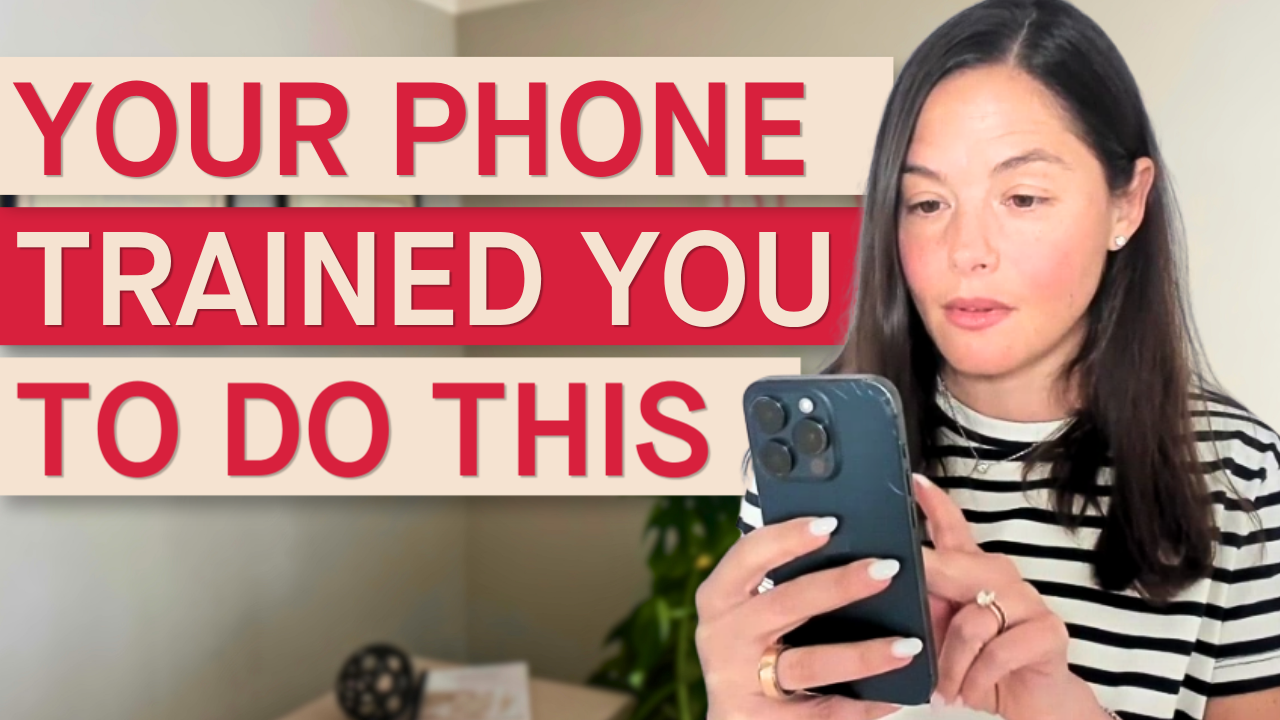
Emotional Eating Unwrapped (Sober Eating Podcast): EP 143
You reach for your phone the moment a quiet minute shows up, and food can work the same way: a flicker of boredom or unease, a couple of taps, and you are eating before you have checked in with yourself.
Alana Kessler, MS, RDN, CDN, a registered functional dietitian, looks at how smartphones, delivery apps and constant stimulation have shrunk the gap between an urge and acting on it. She is clear she is not anti-technology. Her focus is rebuilding the pause, the same skill behind a reset she created during a stretch of stillness, because "what has been trained can be retrained."
Takeaways
⦿ Modern convenience can make emotional overeating easier by removing the pause between an urge and the action.
⦿ Boredom is not always a problem to fix; sometimes it is the uncomfortable space where self-awareness begins.
⦿ Food delivery apps, smartphones, and constant stimulation can train the nervous system to expect instant relief.
⦿ The pause matters because it gives you space to ask, “What do I actually need right now?”
⦿ Healing begins when you rebuild the skill of staying with discomfort instead of immediately escaping it with food.
Why does convenience make emotional overeating feel automatic?
Alana's central point is that the gap between wanting something and getting it used to do real work. Waiting in line, driving somewhere, or sitting with nothing to do gave the nervous system practice at staying with boredom and unease. Now a feeling and a food order can sit seconds apart, so there is no room to ask whether this is hunger, anxiety or a passing urge. She cites research linking boredom proneness and frequent delivery app use with emotional and uncontrolled eating, and she is careful not to blame the apps themselves. If food seems to take up much of your attention, this piece on why food can feel like an obsession is a useful next read.
"And the gap matters because the gap between wanting and getting something, this is where the nervous system strength to overcome emotional overeating lives." (Alana, 10:26)
How do you rebuild the pause?
Alana frames this as distress tolerance: the ability to feel discomfort without immediately escaping, numbing or fixing it. The practice is small and deliberate. Let boredom sit a few minutes longer before picking up your phone, notice restlessness moving through your body, and let a craving be there without treating it as an emergency. Research supports the idea that awareness changes eating: mindfulness-based programs improved mindless eating habits such as external eating and impulsive food choices. Some days you may still choose food, and that is fine. If you want one-on-one help with emotional eating, guidance can make the practice easier to keep.
"Freedom is having enough of a skill to choose what you actually need and what you actually want in an intentional and aligned way." (Alana, 32:34)
Key moments in this episode
Click a time to play the video from that moment.
0:14 Welcome and the hidden cost of convenience
4:05 Boredom has been removed from modern life
9:41 We lost the ability to wait
15:39 Why convenience is not neutral
19:45 Distress tolerance and fast relief
22:38 How removing friction removes the pause
27:56 What this means for emotional overeating
30:17 How to practice staying with discomfort
Read the transcript
Full episode transcript
Clean verbatim transcript of this episode: filler words and false starts removed, nothing reworded. Click a time to play the video from that moment.
Introduction
0:00 This is the hidden cost of convenience. It doesn't just make the food easier to access. It can also make emotional overeating easier to execute.
0:14 Hello and welcome back to another new episode of Emotional Eating Unwrapped. I'm your host, Alana Kessler, and today I want to talk about how modern convenience, especially the kind created by smartphones, food delivery apps, constant stimulation, instant access, how this has weakened our ability to sit with discomfort and actually might be a trigger for emotional overeating.
0:38 Okay, so I'm going to get into it. I'm going to talk about five different things and I just want to say that I don't think technology is bad. I don't think your phone is the enemy. This isn't shut off your phone or don't use anything convenient. It's just that the way that we live these days, we have created this environment, and this is a social thing. This is a macro thing where discomfort rarely has to last more than a few seconds. It's not a great thing. If we're bored, you scroll. If you're lonely, you immediately can open up an app and swipe and get into a conversation with a stranger, right?
1:21 You can check Instagram. You can watch something immediately. You have anxiety, you can refresh your inbox, watch TikTok, distract yourself somehow. You get a craving for a food, you can open up a food delivery app and order it and have it in 15 minutes, even less sometimes. On the surface, a lot of this feels like progress, right? It's easier, more efficient, faster. But like I said before, we've lost the ability to be uncomfortable, to sit with boredom without any kind of stimulation. We've just lost the ability to wait.
1:53 We've lost the ability to be in anxiety or restlessness or uncertainty or even awkwardness, right? This suspended state without trying to escape it somehow. And that loss is showing up in how we relate to food and to eating. That's really what I want to talk about today. Because when you train your nervous system to expect instant relief, instant distraction from every uncomfortable or just static feeling or static situation, food can become that automatic response. And the thing with food is that it definitely does work in the short term, but again, it's extremely shortsighted and it rarely moves the needle to give you what you actually need.
2:39 So, let's get into the five things I'm going to talk about today. But before I dive in, I just want to remind you to please like and subscribe. Please follow us on YouTube. We're so close to getting a thousand subscribers on YouTube and it's so fun and it's so great for us. So, if you want to go ahead over there and follow us there, that would be great. Spotify and Apple as well. We're just growing. So, thank you so much for contributing to that.
3:10 And if you're new to me, my name is Alana Kessler. I am a registered functional dietitian. I've been in the health wellness space for two decades already. I myself overcame emotional overeating, huge issues with 40 lb swings in my weight over a 10-year period, and healed myself with a lot of the methodologies that I teach in my programs and also talk about on the podcast.
3:34 So, my life's purpose is really to support people in overcoming any emotional or addictive patterns with food, support you in weight loss if that is what you're interested in, because there's nothing wrong with that, and just really help you remove any obstacles that are in the way from you living your best life. So, if you are new, welcome. And if you are a returning watcher or listener, welcome back. And let's dive in.
Boredom and the urge to escape
4:05 So the first piece we're going to talk about is boredom. Basically, I believe that we have removed boredom from modern life. We've essentially villainized it. We have all these technological advances that have essentially removed it from our life. And on the surface, that can sound like it's a good thing, right? Because like I said, boredom is sort of villainized as laziness. But I actually think that is the big misconception. Being bored is not being lazy. Boredom is not a problem, right? It's a normal human experience to be bored. It's actually almost like a necessary experience.
4:43 There's nothing bad about boredom. It's a neutral state where nothing particularly stimulating is happening, actually. And for most of human history, boredom was just a part of life, actually, right? You waited in line, you were a little bit bored. You sat in a room waiting for something to happen. You were a little bit bored. You drove somewhere, you looked out the window, it was a little boring, right? You stood outside, you had moments where there was actually nothing to do. And in these moments, actually what was going on was this thing that's unique to humans, which is creativity and perception, and the ability to grow these important types of psychological skills were born, right?
5:20 You daydreamed, you noticed things, you processed your life, right? Those things could happen in these very neutral, unstimulating moments. Sometimes the most amazing pieces of art or creations, or sometimes some of the most important advancements that we've had happened when people were bored. I know for myself as well, some of the ideas that I had for my programs that I knew would help people was when I finally just stopped and was thinking about all the women and people that I've helped over the years, and the through line between them, and what could I create to help them.
6:01 The Invisible Weight Detox actually is something that came out of a time of stillness for me. So, it's just so important, and even just boredom, right? Even just nothing happening is totally fine. You don't have to always have some amazing advancement or work of art that comes out of being bored. But now the problem is that the second boredom appears, people have an escape and people immediately go to that escape, right? We pull out our phones, we scroll, we watch Netflix, we will be online shopping. It's just so easy. We check, we consume things from other people, and the boredom just disappears, right? Almost instantly.
6:38 But the issue is that when we never let that boredom feeling exist, your nervous system starts to interpret boredom as something that needs to be fixed, a state of being that needs to be changed. And when we've trained our nervous system like that, it starts to feel intolerable. Right? When boredom shows up, when we feel like there's nothing quite happening, it feels intolerable. That almost tips over into depression sometimes, or that there's something wrong with us, or that we're not meeting our expectations of how we should be showing up to life, right? It can start to become this negative self-talk, this low self-worth rot that starts to come up.
7:20 And this matters with emotional eating actually, right? And there's actually research on this. So, one study on boredom proneness, interoception, which is the ability to understand what's going on in your own body, and emotional eating, found that boredom proneness predicted emotional eating even after accounting for both negative and positive affect. Okay? So in other words, boredom itself mattered, right? Not just sadness or stress or anxiety, when it came to people emotionally overeating, okay? It was boredom.
8:07 Also, when we think of an emotional state that leads to emotional overeating, a lot of times we go to those obvious negative states that are sad or angry or something that's charged. But boredom also, this study is showing, has a predictor for emotional overeating. And the study also found that interoceptive ability, which is, like I said, your ability to sense what's happening inside your body, was also independently related to emotional overeating.
8:38 And that makes so much sense, because if you're bored, but you don't know how to simply just be bored, just be in that bored state, and you're not fully connected to what your body is actually needing or what's going on, and you don't know how to just ride the wave of this, you look for something to escape this state of being. And food does that, because eating gives you stimulation. It gives you something to focus on, right? It gives you that oral fixation, and it gives you pleasure. The tastes can give you this aliveness feeling. It feels like you're doing something.
9:10 And this is one of the ways that smartphones also contribute to emotional overeating, because they teach us that every unstimulated moment can be turned into an entertainment moment. It also trains our nervous systems to always be consuming something, right? Always be doing something. So when there's nothing to do, it feels wrong and we want to consume. We want to do, because we associate consuming with changing the state of boredom. Okay. And obviously, as we know, food is one of the main things that we consume.
Losing the ability to wait
9:41 The second thing is we lost the ability to wait. Okay. Everything has become instantaneous. We don't have to wait for anything anymore, right? You want to watch something, you stream it immediately. You want to know something, you Google, or now we ChatGPT. You want to talk to someone, you immediately text them. You want to buy something, you buy it with one click. You want food, you open up one of the many food apps, right? We've compressed the line between wanting something and getting it. Okay, this is the most important thing. There's no gap anymore between having a want and getting it.
10:26 And the gap matters because the gap between wanting and getting something, this is where the nervous system strength to overcome emotional overeating lives. This is where the awareness starts and the training for the behavior starts to also take hold, right? It's where you get to ask yourself, do I really want this? Do I need this? What's going on? Is this actual hunger? Is this anxiety? Is this a passing urge? But when everything is instant, the waiting and the getting, they happen so close together that there's no room for this kind of self-inquiry. Right?
11:03 Immediately you feel uncomfortable, you act, right? You feel lonely, so you snack. Right? You feel anxious, you snack. It's just this immediate automatic thing. And by the time that you realize what's happening, a lot of times you're already eating, which is why so many of my clients feel like it's automatic, because we're not trained in this waiting situation, right? There's no friction anymore between the urge and the eating, right? You don't really have to plan anything. You don't really have to do anything. You don't have to go to the store, right?
11:34 You don't have to prepare. You don't have to cook. You don't have to prep, right? You don't even have to speak to someone and have someone hear your order anymore, right? You tap a button and the food just appears, right? Another study that I was looking into on online food delivery apps and young adults found that more frequent use of these apps was associated with less healthy eating behaviors, especially increased uncontrolled eating. Okay. The study also looked at depression levels and attitudes towards these apps, which matters because emotional state and access are not separate.
12:08 When someone's already feeling low, stressed, right, dysregulated, when someone's already feeling that way, instant food access can become a part of that coping loop. And I'm not just talking about the food, getting the food, and eating the food. I'm talking about the fact that now you've asked for something and you got it immediately, okay? That is also an important piece of it, right? It feels like you're getting something, like you're being listened to, you're being heard, you're being seen, right?
12:36 And I don't think that's a coincidence, that they're intertwined, right? Food delivery apps, they remove the pause, but they also kind of take away where you might have been able to build the skill of learning how to be there for yourself, because without that skill, the urge becomes the action now, right? The urge becomes intertwined with this action. And I'm not blaming apps, right? This isn't like I'm blaming apps. I love the apps, right? I use Uber Eats all the time. I order from apps all the time. So, I'm not talking about that.
13:09 It's just about understanding the environment, right? I just want us to understand the environment that we're living in. A world right now that's designed to collapse the space between desire and gratification. Right? This is the world we're living in. Our environment is constantly taking away this really important skill of waiting, of pause, of checking in with ourselves and being with ourselves. And emotional overeating, it thrives in this collapse. Okay? So, understanding that our behaviors become a product of what our environment is promoting, and this is what our environment is promoting.
Convenience and fast relief
15:39 The next thing is convenience is not neutral. Okay, that's why I think we need to talk about convenience differently, because we usually talk about convenience like it's automatically good, right? And in many ways it is good, right? Convenience can make life so much easier. It could save time. It can reduce stress. It can help people as it relates to food. It can help people access food much easier when they're busy, tired, disabled, overwhelmed, caregiving, working long hours, right? Stretched thin. So I'm not demonizing convenience here, but it is about asking what happens when everything becomes convenient, right?
16:22 What happens when every need, every urge, every craving, every time you're bored, every emotional dip, every moment of discomfort can be answered immediately? Okay. And so another study was actually a 2024 systematic scoping review on convenience as a dimension of food environments, right? It found that convenience is a major driver of food choice, but it is often inconsistently defined and measured in nutrition research. Okay. So a lot of nutrition research, they don't consider the convenience piece, right, when they're talking about why people choose certain foods.
17:02 So, the authors of the study proposed thinking of convenience as something that reduces the time, physical effort, mental effort, and skills for planning, acquiring, preparing, eating, storing, and transporting or cleaning up food. And I think that definition is so important because convenience is not just easy, right? Convenience removes effort, and we need the effort. We need to have this skill of effort in order to be able to not be a slave to our urges, right? And convenience removes planning. It removes decision-making, and again, it's helpful sometimes, right?
17:39 Sometimes it removes the exact friction that would have given you that valuable skill: learning how to pause and ask yourself, what is my motivation for eating this? Is this actually what I want? Is this going to meet the need that I think it's going to, right? Or am I just trying to escape a feeling? And so this is the hidden cost of convenience. It doesn't just make the food easier to access. It can also make emotional overeating easier to execute. And it's not because of you, right? It's not because you're particularly or specifically trying to sabotage yourself, but because the environment has made the fastest choice the easiest choice, and therefore the choice that you're most likely to pick, right?
18:28 And when you're already emotionally uncomfortable, your brain isn't going to be looking for the most nourishing, the most skillful, or the most aligned option with your ultimate long-term vision for health. And it's just not. It's just not. And the next thing is we trained our nervous systems to expect fast relief. That's what we've done with our society, with our environment. And our nervous system is always evolving. It's a great thing, especially if you're healing from any kind of traumatic experience. It's why we can heal, because our nervous systems can evolve. But if we don't evolve them in a way that's to our highest benefit, it can also devolve.
19:07 Our nervous system is always adapting based on what we repeatedly do. That's why repetition is so important when it comes to changing behaviors, and repetition is also really important when it comes to behaviors that might not be so great for you, right? And if every time there is discomfort, this type of relief, this immediacy like scrolling, shopping, eating, ordering, is available, your nervous system just starts to be trained in this fast relief. What it learns is that discomfort shouldn't last. Right? Discomfort means that we need to change the state and escape immediately. Right? Discomfort means that we need to do something now.
19:45 And this is where your tolerance for discomfort becomes weak. And the only reason it becomes weak is because you're out of practice of tolerating distress. Right? And distress tolerance, it's your ability to experience emotional discomfort without immediately needing to escape, numb, fix, or react to it. Okay, this is called distress tolerance. And it really matters. Having high distress tolerance really matters, because there was a study, a meta-analysis looking at distress tolerance across substance use, across disordered eating behaviors, borderline personality disorder, different things, right? Different situations, found support for distress tolerance as a transdiagnostic factor.
20:43 Meaning that low distress tolerance, it's not just connected to one issue, right? It shows up across patterns where someone is trying to manage internal states through an external behavior. Okay. And we saw this pattern of low distress tolerance among many different types of people with many different diagnoses. Being able to regulate their emotions and needing an external behavior to help them regulate emotions was the consistent thing amongst all of these people in the study with these different diagnoses. And so what I want you to hear is the emotional overeating is not always about the food.
21:24 Now we know this. I talk about this all the time, but sometimes, and a lot of times, it is about having this ability to tolerate distress. Because what happens when that feeling of distress rises in your body, right? Whatever distress feeling that is, and we talked about earlier, sometimes it doesn't have to be some charged feeling. It could just be boredom that your body registers as distress. But what happens when that arises and you don't have the internal capacity to stay with it? Food becomes the relief, right? And not because the food is so tempting, right? And it's not because food is what you really want, but food is fast, right?
21:54 Food is this reliable thing to consume that changes the state. It's usually easily accessible, right? And it does work, right? It does work for a very short term, but it's not a true solution, right? It's not a true solution. And when your nervous system has been trained to seek this immediate relief, a lot of times food is what it will reach for, right? A lot of times food is what it will reach for, because you're not in the state of mind and the state of interoception with yourself to say, what is the real need here? All you're asking yourself is, what will make this stop? What will make this go away? What's going to change my state? Okay? And food will change your state, but for a very little while, and it's not a long-term solution.
Friction and the pause
22:38 And the last thing this convenience culture has done is that it's removed friction. Okay? And I talked a little bit about this with the food apps, but we can be taught that having friction, having a little conflict, having a little challenge, right? Convenience removed challenges, and challenges are not a bad thing, but we've removed challenges in so many different areas, right? We've removed challenges when it comes to having takeout. We could just do one click, right? We've saved our passwords. We don't even have to remember what our passwords are anymore.
23:16 I've done this a million times where I've just forgotten what my passwords are, but Google remembers it in my manage passwords in Google, so I don't even have to think. Right? There's this autofill, right? We have algorithms that predict what we want before we even fully know we want it. And then we're like, "Oh my god, I need that." Right? Everything is designed to anticipate for you and then make it really easy for you to get this thing that they've anticipated for you, that now you're like, "Oh, I want this." And sometimes it can be great, right? Sometimes it can be really great to not have to do the heavy lifting, to not have to do the research, to not have to have any challenges in the way.
23:47 But friction and having challenges, it serves a purpose. It puts that space between the impulse and the action, which as a human is so important, because in that space, that's where we get a chance to choose. That's where we learn how to make decisions, right? And this is one of the biggest things I hear from the people that I work with: they don't trust themselves. They don't know how to make a decision that they know is going to be good for them. And that's because this space where we used to have to learn how to do this is no longer. It's no longer.
24:17 So, we don't have the time or the space to say, "Do I really want this? Is this aligned for me? Is this going to help me? Is this what I'm actually needing right now?" Right? When there's no friction, when there's no challenge, there's no pause. And when there's no pause, there's no choice. There's just impulse and there's action. It's very primitive. It's very reptilian, right? We have the discomfort and then we have the food. This is why emotional eating and emotional overeating specifically can feel so automatic, because in many ways it actually is, right?
24:45 Our environment has removed the obstacles that used to slow the pattern down. Right? If food is in the house, it's super easy to grab. Right? If you're emotionally charged, it's one tap away. The distance between feeling something and eating becomes extremely narrow. And then afterwards you'll wonder, how did I end up here again, or you feel like it completely has power over you. But the answer is so simple: there was no pause, because convenience has removed the pause. And without the pause, your nervous system, it did what it has been trained to do, is that it reaches for immediate automatic relief, a change of state, distraction.
25:30 Our nervous system is trained with awareness and without awareness. And that's why it's really important that we always bring awareness to our nervous system state, because at the end of the day, we've lost the skill of staying, right? We've lost the skill as a society, as a culture, of staying with discomfort, of staying with boredom, of staying with longing, right? Of staying with a feeling and not getting immediate gratification. And this comes with food, this comes with anything, right? I think about even dating and relationships, right? We text someone, we automatically need to text them and want to get texted back. If we don't hear back from them in 10 minutes, we think something's wrong.
26:12 But learning how to be with awkwardness, learning how to be with not immediately getting your instant gratification, is a real skill, right? We need to learn how to stay with the uncertainty, the sometimes icky feeling of being human. And it is a real skill. There's a real skill that I teach in my programs, actually in all of them, to be honest, right? And it's not a glamorous skill. It's actually not glamorous. It doesn't feel productive, because actually you're staying, right? It doesn't give you this quick dopamine hit. And honestly, it won't even make you feel better right away.
26:44 But it is probably, if not the most, one of the most important skills that you can build and that you need to build if you want to stop emotionally overeating, if you know that this behavior with eating is what's causing your weight gain and you want to lose weight. Because so much about weight loss, so much about emotional eating, is not actually about food. It's actually not. It's about being able to stay with the feeling, the emotional state, the nervous system state that came before the food, before the eating experience, right?
27:15 Whatever emotional state that is for you, whether that's anxiety, loneliness, shame, frustration, resentment, boredom, right? Whether you feel unseen and unheard, right? Whether you just feel overwhelming pressure to do everything for everyone, to hold everything together, right? Whether the discomfort is you want more from your life, or you feel like you're not at the place in your life where you want to be and you don't know how to get it, or maybe you're in a situation where you feel trapped and you don't know how to ask for what you need or what you want. Right? All of these things, food becomes the exit ramp. Food becomes the fastest way out of the feeling for many of us.
Closing thoughts
27:56 Okay? And I want to be clear. This isn't a shame thing. This is just taking the hood off of something and giving you a really clear way to see the pattern. So, what does this actually mean? Right before we end, let's just wrap it up. What does this actually mean? It means that emotional overeating is not always about cravings. It's not always about willpower and lack of discipline or having a meal plan. We've eliminated boredom, so we lost the ability to be bored. We made everything instant, so we lost the ability to wait.
28:33 We removed challenges or friction in getting what we want in that situation, so we lost the ability to pause and be still. And we've normalized constant stimulation, so stillness started to feel threatening for us, and we lost the skill of just being with ourselves. So when discomfort appears, food becomes the solution. And I think once you understand this, something important can really start to shift, and you stop making this emotional overeating, this cycle with bingeing or emotional overeating and weight gain and dieting, you stop making this such a huge main character of your life, and you stop thinking that this is a problem that you have because of you, right?
29:16 You could stop thinking, what's wrong with me? You don't have to think that, because you start to see that this is very depersonal, right? You can start to depersonalize it. You can start to see the real pattern that your nervous system is trained from your environment. But like I said before, what has been trained can be retrained. That's the amazing thing about our nervous systems, right? That is the amazing thing about neuroplasticity, about our nervous systems, is that you can rebuild the skill of sitting with discomfort. You can rebuild it.
29:43 You can rebuild the pause, being able to be in the pause and learn how to make a choice and make decisions and feel trust and confidence in that, right? You can learn how to feel an urge or a wave of emotion arise in you without feeling like you need to change it or obey it immediately. And that's where freedom starts, right? We call it food freedom, but it really just is life freedom. And so, how do we rebuild it? Right? How do we rebuild it?
30:17 We practice staying, right? We practice staying gently, intentionally, in small moments, right? You let boredom exist for a little while longer before grabbing your phone, maybe. And I'm not saying you have to put away your phone. I'm not demonizing phones. It's fine. But maybe you just feel it. You're about to reach for your phone and you just give it 3 minutes, right? Just that little extra, right? You feel restlessness maybe move through your body a bit before walking into the kitchen. Okay? You let the craving be there without immediately feeling like you have to be overcome by it, or feeling like there's something wrong with it.
30:49 It's okay to feel cravings sometimes, right? And you let yourself feel uncomfortable, not because you're a sadist or a masochist or something, right? It's not because you're restricting or you're following a rule again, right? You're not doing that, but it's just a way of retraining your nervous system, right? It's basically just reinforcing this maturity of saying, I can feel uncomfortable and still be okay, because it is a bit of an immature type of way where we have to find relief for every discomfort, right? Children have that element to them.
31:22 We're training our nervous systems in maturity, right? That this feeling doesn't need to be escaped immediately, right? I can pause. I can wait. I can be uncomfortable. I can make a choice that might not immediately make me feel better, but it makes me feel good because I'm aligning with a more mature, higher version of myself. And the discomfort is fine in there. And that's the skill that changes everything. Because once you can stay with this discomfort, even briefly, you're no longer trapped in the automatic loop. You have agency. You have choice.
31:56 You don't have to feel like food is this monster that is overpowering you, right? You don't have to. You can start to be there for yourself and give yourself other tools in the toolkit other than food. Okay? And I just want to say that sometimes maybe you will still choose food here. I always say that this isn't about never emotionally eating, right? This isn't about that. It's just about feeling like food is not your only option. Okay? Because freedom is never about never having the urge, right?
32:34 That's not what freedom is. That's just not a realistic thing. That's not what freedom is. Freedom is having enough of a skill to choose what you actually need and what you actually want in an intentional and aligned way. Okay, that's what freedom is. It's to know that you were in full command of whatever choice you made and it was not automatic, even if that is sometimes food. So, that is all I have for you today. Thank you so much for listening. And like I said, please rate us, review us, give us five stars on Spotify, on Apple, YouTube. I will see you next time. I'm Alana and thank you for listening to Emotional Eating Unwrapped.
Related episodes
Hunger or dopamine? - how quick rewards shape cravings
Emotional eating and nervous system numbing - food as a fast state change
Distraction from healing - what constant distraction costs you
Work with Alana
Start here: Invisible Weight Detox
An introduction to the Sober Eating Movement that finally gets your body and mind working together in under 30 days, so you can reclaim your personal power, lose weight and keep it off. No tracking, no shakes, no endless rules. It's a clear step by step process that helps you reclaim your self worth, eat like a normal person again, and watch the number on the scale move in the right direction. Enroll here
The full method: The Sober Eating Sequence™
The proven 3-phase method to stop food and dieting chaos, and release weight naturally through a new proven way of eating for weight loss and enjoyment - without dieting, restriction, or counting macros in as little as 90 days. This is where you finally trust your body and food choices, feel at ease in your skin, and stop circling back to food as the problem. Enroll here
1-1 support: Elite VIP
A 3-month private mentorship where years of struggle collapse into months of precision change. With custom meal development refined daily, private coaching intensives, and direct access to Alana, you’ll stop negotiating with food and step into the woman whose body, confidence, and choices reflect her true power. Apply here
1-1 support: Concierge
For the woman who refuses to settle, Concierge is the highest level of private mentorship. With unlimited access to Alana for coaching, every detail and nuance is addressed with luxury-level concierge private support tailored to your real day to day life, so you experience the deepest transformation possible and embody full freedom. A luxury 3-day 1-1 weekend retreat with Alana is included. Apply here
Coming Home to Your Body
A program designed to support your Sober Eating Method journey. A self-paced course to help you feel safe, grounded, and at peace in a body that's still changing. Learn to build trust with your body now, not just after weight loss. Enroll here
Free quiz
What’s your hidden food and self belief pattern keeping you from lasting weight loss? Take the free quiz
Ask a question for a future Q&A
Leave a voice message for our next Q&A episode.
Listen and subscribe
Follow Be Well by AK
Disclaimer: The information shared in this episode and on this website is for educational and informational purposes only. It is not a substitute for professional medical advice, diagnosis, or treatment.