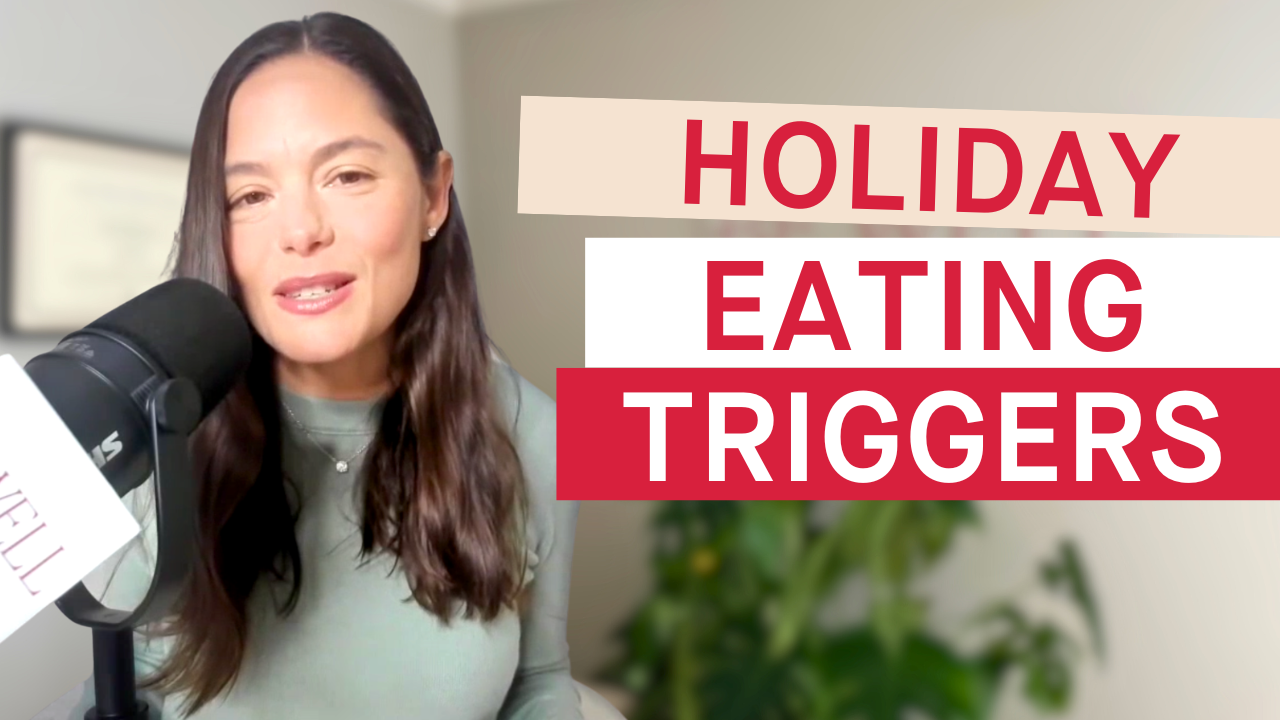
Emotional Eating Unwrapped (Sober Eating Podcast): EP 65
You walk into a holiday gathering with a plan, and somewhere between the buffet, the opinions at the table and another trip back for a plate, the plan is gone. Then the all-or-nothing voice shows up and tells you to let it all go until the new year.
Alana Kessler, MS, RDN, CDN, a registered functional dietitian, and co-host Kassi talk through why the holidays hit so hard and what actually helps, from bringing your own food to saying no without explaining yourself. Alana sums up the aim simply: "The goal is neutrality." If you want support for staying neutral around holiday food, this episode lays out where to start.
Takeaways
⦿ Holiday overeating is often about avoiding tense conversations, not hunger.
⦿ Thinking through the stress before a gathering makes it easier to handle in the moment.
⦿ Bringing your own food only helps if you have the inner strength to stand by it.
⦿ You can turn down food kindly without explaining your reasons to anyone.
⦿ The goal is the same neutral relationship with food in December as in May.
Why do the holidays make emotional eating harder?
Kassi admits that when family conversations get tense, food becomes her exit: another plate or a little grazing is easier than disagreeing. Alana points to the setup itself. Holiday food is often served buffet style and stays out for hours, which is hard when you are not connected to your hunger cues, and one extra trip can tip you into an all-or-nothing spiral.
"a lot of the gatherings and a lot of the parties like food is there but it's not you don't have to engage with it" (Alana, 8:06)
Her main tool is thinking ahead about what might stir you up. Alana's guide to staying well through the holiday season covers the practical side.
How do you say no to food without overexplaining?
Kassi asks for language, and Alana describes a familiar scene: someone made a dish just for you and is watching to see if you eat it. A warm "thank you, maybe I'll have it later" is enough, and you do not owe anyone your reasons. Some people will react, and that discomfort is part of the practice.
"I think that in general, emotional eating is a coping mechanism for not liking discomfort" (Alana, 26:03)
It also helps to keep the stakes in proportion. An NIH study on holiday weight gain found the average gain is about one pound, far below what people expect, though it tends not to come off afterwards.
Key moments in this episode
Click a time to play the video from that moment.
0:18 Alana and Kassi open their holiday episode
4:01 Using food to avoid opinionated family
8:45 Should you bring your own food to the holidays?
10:01 Why eating before a party rarely works
17:43 The corn muffin test and setting yourself up to win
24:08 Saying no when someone made a dish for you
32:03 Why the goal is neutrality, not perfection
36:14 Luck is really preparation
Read the transcript
Full episode transcript
Clean verbatim transcript of this episode: filler words and false starts removed, nothing reworded. Click a time to play the video from that moment.
Introduction
0:00 You prepare to be able to go into a holiday meal and feel neutral. And maybe I walk out, maybe I overdid it a little bit, but I'm totally fine. And I still go to the next thing. I come out of the holiday season same, feeling the same, looking the same, all that.
0:18 Hello and welcome to another episode of Emotional Eating Unwrapped. I'm your host, Alana Kessler, and I'm here again with Kassi, co-pilot Kassi. Say hi. Hi, everybody. I'm excited cuz we are here to talk about the holidays. This is essentially, I guess, our holiday episode. Kassi has a nice festive tree in her back in the behind her. I know the Christmas spirit needed to come early in my home, that's for sure.
0:52 Yeah. I And you know what? This would not be where I put my menorah. But because there's it would be too close to the wall, but perhaps I will put one here next time for a little holiday spirit next time. Exactly. Yeah. My husband, he's Catholic. He does not well, he grew up Catholic. He's nothing he doesn't he's not really religious at the moment or really much anymore, but he's anti-tree and I'm like yes and I'm all about like and all about the festivities and all the accoutrements but he's not really into it.
1:32 But maybe now that we have a house instead of an apartment in New York and now we have a house cuz we live in Kentucky he will change his mind. I'm going to get on him for that. You just have to slowly chip away at the holiday spirit with them. Exactly. But we are here today to talk about eating and the holidays because definitely that is something that in all my years of doing this work.
1:58 I definitely have seen that the holidays can bring on a lot of anxiety, a lot of stress. And I don't I feel like it's warranted. And definitely there's so many things that happen around the holidays that can trigger that stress, that anxiety, and can be really it can be really difficult to either stick to your goals, not fall back into old habits. And you know, I think that it's important to acknowledge that this is a time of heightened emotional sensitivity.
2:48 And I always find that when we can name these things or start to think about these things before they start to happen, it really helps with the ability to manage it and navigate through it once it does happen. I'm a huge believer in like pre-thinking about things. And so this is a this is a tactic that I want you guys listening to take with you as you go through the holiday season.
3:20 And I'm kind of giving you my advice in the beginning of the episode, but I definitely feel like that the ability to acknowledge early on some of the feelings that you might be having about the holidays coming up and starting to prepare and plan for how you're going to manage that and navigate that. I would say that's probably one of the biggest tools that you could put in your toolkit to ensure that the holidays are going to be le you know can be less stressful for you.
3:53 And so Kassi, what's your experience with the holidays? I'll share some of mine, but yeah, sure. When I think about the holidays, I just think about like the chaos to be honest with you for the most part when it comes to like social gatherings, I should say. And my family is very opinionated, I would say, and I often don't agree with them. And so I tend to I don't know, when it comes to eating in the holidays, I find that I use that as an avoidance tactic cuz it's like, oh well, that's the I don't know the neutral thing. Like there's always going to be like food around and so it's like oh okay don't really agree here so like let me go let me go get a second plate or like let me go and like graze
4:42 Or something like that to avoid kind of like having those conversations and so it's funny that you say that cuz like I don't think that I or that we're having this conversation cuz I never really thought of it before like that especially because I mean I am no stranger to like doing that and then afterwards being like why do I feel kind of shitty because I did that so much I did a surplus of just avoiding it and just like kind of stuffing my face after.
5:12 So when I think about eating the holidays, I think of that not necessarily like in other contexts, but more so with that specifically because and when I when I take a harder look at it too, I'm kind of like, oh, there's that avoidant like attachment, I guess you could say, like showing up for me and being like, okay, well, what can I do to kind of like get out of this like kind of situation?
5:42 I don't want to be in for sure. I definitely think that avoiding using food to avoid uncomfortable scenarios is for sure one of the huge ones. I can totally I can totally relate to that also because so much of the holiday eating style is buffet. I don't know about you, but it's like the food is out for a really long time. And I feel like that is hard for people that emotionally eat and or even just aren't necessarily connected to their hunger cues or you know does have a relationship does do have a relationship with food that you know might feel a little bit more not always motivated by hunger per se. And you can feel a little bit more seduced by food when it's around.
6:30 And I think that's what makes the holidays sometimes even harder because often times it's not only the sheer amount of holiday gatherings or like events and the there's also the stress of the social stress like you've said, but the amount of food that's there for that long of a time, I think could be a really big trigger. It definitely was. It definitely was for me. I found myself when I was struggling more you know grazing definitely like going back and then all of a sudden it hits you that you've gone back so many times and then that can kind of get you into the spiral cuz you're like oh crap I already just kind of like ate too much and it kind of just takes you into that place of all or nothing.
7:29 I wasn't perfect. And all that all that type of stuff. And I found that to be the hardest part because it almost seemed like it ne it didn't end. It was like there would be the that one holiday party and then two days later there's another one and then and so I think for me and what I try to tell you know the women that I work with now is to remember that it's not about the food right a lot of the gatherings and a lot of the parties like food is there but it's not you don't have to engage with it.
8:18 Totally. I think what's interesting too is like the accessibility of the food and your kind of like desire to refrain from it or you know what have you. But what I think is interesting is.
Bringing your own food to holiday gatherings
8:38 A lot of times we think oh if I in the in the preparation aspect I think a lot of people's minds goes to can I bring my own food and what's your perspective on bringing your own food to the holidays? You mean like not because you're contributing to the meal, but because you're bringing your own meal, right? For maybe quote unquote safe foods that you feel comfortable.
9:05 Yeah. I'm a huge fan. For me, like I think whatever you need to do to make yourself feel safe and good and prepared, you do. I think the hardest part is sticking to that. Yeah. The opposition that comes with it. The opposition that comes with it, the people's comments. It's like that's why it's like to heal from emotional eating, you have to build a strong inner power because it's less about the actual food per se and it's so much more about the voices in your mind like the voices in your head that even if you bring your safe food, it's like it's like going to the gym, standing on a treadmill, but not really doing it right.
9:54 It's like you bring your safe food, you eat your safe food, but then you end up eating anyway, right? It's one of the reasons why I'm not a fan of eating in advance of going to a party. Some people will say like, "Oh, well, I don't want to eat the food at the party, so I'll eat my lunch in advance and then I'm going to go or I'll eat my I'll eat dinner my quote unquote healthy dinner at home and then I'll go to the party and I'll be less tempted at the party cuz I already ate."
10:25 That's totally that never works, right? Because we're not eating out of hunger anyway. We're eating out of because of feeling pressure, because of wanting to participate, because of a lot of other emotional reasons why we're eating. And so I am a fan to get back to your question. I am a fan of bringing your own food to something, but it's up to you to hold yourself responsible and say, "I brought this.
10:54 This is what I this is the food I'm eating here, and regardless of the other pulls that I have towards eating the other food, I'm not going to do that." Right. I feel like that's like boundaries on hard mode because you're not only like bringing something that's not like on the typical menu, but you have to essentially like stand empowered in it. You know what I mean?
11:24 Where people are going to be like, "Oh, you're not going to eat like come on eat like the turkey dinner or oh, come on, eat these mashed potatoes or whatever." In compar like in lieu of the healthy food or the safe food that you brought with you. Cuz then it's almost like bringing attention to the food that you brought. And I think that like you said, it's like you have to have a really strong foundation to be able to stand in that and be like, "No, this is exactly what I'm doing." so it feels like the advanced version of it.
11:55 I mean, it's advanced, but it's it you know, it's the whole thing. Yeah. We're talking about the holidays now, but I mean that's the advice I give to my clients and students all the time. But it's but like you but like you just said, it's not something that you can it's not something that you can just it's not like making sourdough bread? It's not like you can just you can just get the instructions and then implement.
12:22 It's something and then you do it. You just follow the instructions then you get the bread loaf, right? Like this is something that you need consistent support reinforcement practicing, right? It's like if you want to start deadlifting 350 lb, you don't you don't start with 350 lbs. You have to like train your muscles to be able to get to the 350 lbs. It could take months. It could take a year, right?
12:42 And so that's what I do with my mentorship with my students and my and my and my clients in the mentorship because I've realized that in order to be able to show up to a holiday season with this strong core, this strong inner power, these boundaries, this ability to have that, it's not something that you're going to be able to just download a PDF with instructions and you're going to be able to do it for the holidays.
13:12 It's something you have to train yourself up to do all the time. And I think that's what's missing when it comes to people wanting to have success overcoming emotional eating, being able to stand the holidays because to be honest and even and specifically for people who want to lose weight forever where they're not yo-yoing back and forth because to be honest, at this point in my life, I don't feel any different around the holidays than I do around my normal everyday eating.
15:45 To me, it's like completely the same. Okay? Maybe there's more food around, but the way that I behave around food and the way that I engage with eating is exactly the same in my regular life in it's exactly the same in November and December as it is in May. And so I think that's training that ability to be able to have that consistent neutrality around the food where it doesn't you know where you don't feel like you're succumbing to all this seduction about food and is something that you have to train up when it's not the holidays to be honest.
16:36 Yeah. I feel like it reminds me a lot of what we talk about quite a bit, which is going into the wild and getting that feedback that you were mentioning before, but going into the into the wild and like actually practicing the things that you've prepared for. And it might not be perfect and it might not go the way that you intend, but like you said, that planning and that kind of practice that you've built up to get to this point is like what you hold on to.
How to set yourself up to win
17:07 100% and setting yourself up to win really setting yourself up to win. Also, I had you know, one of the students in the mentorship, we have these weekly check-ins where they can send me a question, a personal question, and I give them you know, personal coaching answer every week. And one of them I was just reading it today was like I baked cookies I baked cookies for myself, my favorite cookies, and I took them out of the oven and I only wanted to have two, but I ended up eating most of them.
17:43 And I remember this so clearly when I was struggling with binging and emotional eating. I love corn muffins and I would make these corn muffins and I'm telling you, I would have this conversation in my head before I made the corn muffins. Like I would, it's almost like I was testing myself to see if I could make the corn muffins, 12 corn muffins, and not eat them and not eat them.
18:02 Like I needed to prove to myself that I'm healed because I can keep I can have one and I'm good. It never worked. It never worked. Right. And so I realized that I can't I can't put a stumbling block in front of myself to make myself fail, right? And I feel like that's sometimes what people do around the holidays. They give themselves permission to kind to do these types of stuff that are not in service of the higher good for themselves.
18:30 So, one of the tactics that I teach my clients and students is to only keep single servings of foods of like snacks and indulgences that you like in your house at one time. Making a batch of cookies that you love where there like is like a huge no, right? Because all it's doing is especially if you're still struggling like now I think I could now I could do it you know now I you know I've trained myself all these years I'm recovered I can make myself this I can make myself the corn muffins and probably keep them in the fridge and have one but I'd probably have one a day that wouldn't probably make me feel good you know in the end maybe but I never in a million years would have you know I never in a million years would recommend and making a dozen
19:36 Baked goods a dozen cookies and test yourself. And so you have to kind of say to yourself, how can I set myself up to win? And you want to do that going into any of any of the holiday stuff, any of that. And that's unique for every person. But that's another thing that you can ask yourself before you go into any holiday situation or that's going to have a lot of food.
20:04 How can I set myself up to win here? Is it bringing your own food? Is it you know having a you know making sure that you consider in advance what emotional stresses that might happen and you make sure that you giving yourself that nice soothing you soo yourself beforehand. And so there are all these things that you need to do because emotional eating isn't just about the food.
20:21 A lot of times it's not just about having seductive foods there. It's like what you said, Kassi. It's like having social triggers that end up causing you sometimes to eat when you know to eat and that's not what you necessarily want to do. I like that you said set yourself up to win because I think a lot of especially in the holiday situation, a lot of us go into it being like with the game plan of like what if I already fail like what if I overeat like or when I inevitably overeat?
20:55 With like that failure plan in mind it takes away from ever having the possibility of winning. And so when you kind of go in with a mentality of like what can I do to prepare so that I can have a very successful day and like not be tempted or feel the emotions that I feel when I emotional emotionally eat or any of those things. It's a much different mindset than going in and being like, "Okay, well, I need to have a game plan on how to repair the damage that I haven't already done but don't trust myself not to do."
21:36 100%. Yeah. I mean, so many people go in with these really high expectations for themselves and then before they know it, they have given up on themselves. And a lot of times it's because of our own inability. I don't know if it's an inability, but a lot of times it's because of our own lack of that inner strength. Because of the conversations that we have in our head about what that inner strength is, right?
22:11 We're worried that it means we're dieting if we have boundaries around food. And I think that's a really big one, right? People want to be able to eat like they don't want to feel like they're dieting, so they set themselves up to fail when there's like a really big in between area. In that.
How to say no without overexplaining
22:41 I think what is interesting around the whole social gatherings and holiday season is that there's not a lot of verbiage around how to communicate that to the people that are around you. Like when I think to myself about explaining to somebody or setting that boundary because you're not only setting a boundary with yourself, especially when it comes to the holidays, you're setting it with the people or that are inevitably around you, whether that's family, friends whoever you're spending the holiday with.
23:14 And so I feel like there's it's not taboo is not the word I'm looking for, but just like uncommon the like the language around it. We're not familiar with the language around what it looks like to be like I'm full or no thank you like you know and not only to have to say that to yourself you know and stand in that and be like I don't I don't feel the need to have another serving or something like that but also when somebody else is perhaps pressuring you or like it could be a gentle like let me grab you another plate or are you done like there's an additional temptation in that to have somebody else say that.
23:54 And so I'm curious on if you have any advice in terms of like what that language might look like to stand empowered in that choice. Yeah, I mean it's definitely I definitely can relate to that. I mean, I would always tell I this still happens all the time. Where I go somewhere and someone will I'll be eating something and they'll be like, "Oh, did you have that?
24:25 Did you have that quinoa salad? I made that for you." And I made it specifically for you because I knew that you like that. Yeah. Oh, you're not going to have that? How Oh, you're not. Okay, I guess. Do you not like it? Right. So now all of a sudden you have to make do you not like it or you know, you feel like you have to eat something because somebody else made it for you or in order to make the other person feel validated that you appreciate them and that you love them because you're eating their food even if you don't necessarily want it.
24:59 And so what I think is really good to do is I think it's just I think that when somebody says to you, I think that the biggest thing to do is when someone says to you, here, have this. You can you can say to them I'm not thank you so much. You could say, thank you so much. Maybe I'll have it later. Right. You don't have to necessarily say no.
25:34 You don't need to clue in everybody to your int to your motivations for why you're not eating. I don't think that's necessary. And I think that's something that we have to get comfortable with. We also have to get comfortable with the fact that people are going to be they're going to have their own emotional reaction to our choice of behavior. Yeah. They might have a negative reaction.
26:03 They might say something that's judgmental, but I think that in general, emotional eating is a coping mechanism for not liking discomfort. And so, getting comfortable with discomfort is the like is kind of the what am I looking for? It's kind of like the secret sauce to overcoming emotional eating. And getting comfortable with discomfort is similar to, like I said before, going from never lifting a weight in your life to deadlifting 350 lbs, right?
26:34 Like it's not something that you can, like I said, download a download a how-to guide. This is how you get comfortable with discomfort and then all of a sudden you implement it and you're comfortable with discomfort. It's a practice and a state of being that takes a long time to grow within yourself. And so, and you know, and so it is uncomfortable every time I have to say to somebody, I don't want that.
27:06 I get a weird look. I get a vibe. The person walks away. I'm like, oh, that was annoying. But I don't that doesn't affect me anymore in the sense of where I feel like I'm going to either I'm either going to give in and eat it anyway to kind of be a people pleaser, right? I'm not going to be a people pleaser and I'm also not going to fight with them about it, right?
27:21 Like I'm not going to overexplain and say and give them my reason, right? No is enough or just kind of and no in a nice way, right? Like being like maybe later or you know I'm not hungry for that right now but yeah that looks really good like I'll try that later. Like there's gray areas. There's middle ways to show somebody that you appreciate the effort and you think that it's and that they've done a really good job and it's probably great. But you don't also have to engage in it for that to be you know for that to be a real thing.
Neutrality instead of perfection
29:54 Yeah, ex. That's great. Like I love that. I think that's such a great message and I think that's a big practice of getting out of that perfectionist mindset because on some level it's easier sometimes to be a perfectionist. It's easier to be a perfectionist because then you can let yourself go. And so I do want to name that a little bit in the holidays. I think a lot of people just go into this time of year just throwing it all away and they're just kind of like gh it's never going like it's going to be a you know it's going to be a show anyway and you know whatever and so I'm just going to I'm just going to like let myself I'm just going to let it all go and then I'll come back afterwards
30:41 And start over. Right? It's like that starting over mentality that never really gets us anywhere long term. And so when people are listening to this, I really, your message, Kassi, is so being able to being able to be okay with not being perfect and learning that learning how to be, how to stay consistently in a beingness of not being perfect takes practice. Because as humans, we're much more comfortable with the black and white, with being perfect or letting ourselves go completely.
31:14 And so if there's any just takeaways that I want people to have from this is that it's up to you to say I'm going to go down the middle road of good enough and not being perfect and you know and continuing to try to have the boundaries, have the good communication skills, build that inner power even through the holidays that I need for the future. That's going to that's going to get me to a place where eventually it's like me where I don't really feel a difference between the holidays and not holidays.
31:54 That's the goal, right? We want that is to me that's the goal. The goal is neutrality. The goal is sobriety. The goal is that feeling of just calmness 12 months out of the year. And I have calmness and I still can have a piece of cake have my holiday cake and indulgence and love it. It's not like neutrality and sobriety equals deprivation or not having anything. I still have every single thing, but the inner power is so strong that there's just and that's like that is really the north star of it all.
32:34 And again, the takeaway is don't fall into the trap of perfection or letting myself go because if you already have that mentality now, it's going to take like that's the mentality that needs to go away, right? I don't like a meal plan, like a diet, whatever. None of that's not that's just a band-aid. You need to create the mentality of neutrality 12 months out of the year, seven days a week every day of neutrality.
33:16 And then you'll be able to It sounds counterintuitive, but then that's the that's the most flexible thing that you can do. Then you can eat everything. And then you have the trust that it's never going to be something where you walk away being like, "Oh my god, I feel so out of control and now I have to start over. Yeah, for sure. And look, the gray area means that sometimes I wake I walk out of a holiday party being like, "Oh my god, I feel so full.
34:15 I overate." Like I for sure overate there, right? I don't I don't This isn't about being perfect. The neutrality isn't about being perfect at never overeating. The neutrality is that Exactly. Like I definitely in the holidays and even regular weekends during the year I'm like, "Oh man, I overate like that. I feel full." But again, I can be in the discomfort of feeling full and have that knowing and trust that with the skills that the inner power skills and the way that I know how to relate to food now, I will feel fine in a day or two as long as I don't like let this over full feeling make me feel like a failure and then lead me into the mindset of I'm just going to let it all go.
35:03 And I think that the holidays give people that permission to do that because of society and because of the consumer culture of the holidays, right? It's like a six week period where we just kind of try not to let ourselves go. Like that's the marketing, right? Everyone in their mother is going to sell you on products to buy after you let yourself go over the holidays. Whereas I'm basically not doing that and I'm saying just have a neutral 12 months out of the year.
35:38 Learn how to build that for yourself always. And that's something that might be a heavier lift a little bit in the beginning. It might take you like months or even a year to like build that inner strength, but then that is the sustaining long-term solution, long-term support for yourself. Long-term plan that you need for the rest of your life. And so, you're not going to fall prey to these like here's a product to buy in January and February after you let yourself go again.
36:06 You know, it's like you want the luck. We always say like I have client and this is something I used too, but I have clients that used to be like, I just want to be able to eat like a normal person. I want to be one of the lucky ones. And I'm like, luck is not something that it just happens. Luck is preparation. Like you prepare for that.
36:32 You prepare to be able to go into a holiday meal and feel neutral and still be and the neutrality includes eating all of the indulgences. And maybe I walk out like I maybe I overdid it a little bit but I'm totally fine and I still go to the next thing and I'm having the same neutrality and you know I come out of the holiday season same feeling the same looking the same all that.
Closing thoughts
36:59 I love that. Reject the cycle. Exactly. Yes. I just love these conversations and I think that they're so important, especially around this time of year. And I think that these are just like great pieces of advice going in to prepare to have a holiday that you're hap that you can experience the joy of the holidays and you experience like the community and all the things that we want to associate the holiday time with. And kind of take the power back and away from these kind of destructive cycles that we might have been feeling throughout the year.
37:36 And so I don't know, I think this is just great advice. Yeah. And you know what? There's so much there are there is so much stress in the holidays. There is there's a lot of social pressure. People sometimes see family that maybe they don't necessarily would choose to see potentially as adults and maybe there's just some these kind of like subconscious things that arise. And so there's enough stress already with the holidays.
37:59 We don't want eating and food to be another thing that we end up that ends up compounding on that stress, making us feel bad about ourselves, causing extra anxiety, extra you know, like an extra feeling of dread because of how we ate, right? We don't want to we don't want to compound that on top of maybe some of the other kind of minutia nonsense that we get from our social stuff with the holidays.
38:27 Agree. We don't want to like we don't want to be our own bully with the food. Completely agree. I feel like we could talk about this for ages as we always do. I know. I know. All right. Well, we'll wrap up for today. Kassi, as always, love these conversations with you. It's so great. I also got some feedback from people. They love these tandem episodes with you, too.
39:02 So, lots of love for Kassi. I love sharing this space with you. It's amazing and I take away so many of great pieces of advice from them. Not only talking to you but hearing being in your world. I love it. Well, thank you so much and have an amazing holiday season. And to everyone listening, I hope you're enjoying your holiday season. I hope that you are giving yourself love, compassion, care, support.
39:24 We appreciate you so much for listening and participating with this podcast. We love coming every week and giving you just more support, more content. And if you haven't yet, please like and review. If you're watching on YouTube, please subscribe, please like, leave us a comment. We love we love hearing from you. We love we love doing this with you. Thank you again and until next time, I'm Alana and thank you for listening to Emotional Eating Unwrapped.
Related episodes
Enjoying a party without overeating - more on handling food-centered gatherings
People pleasing and emotional eating - for eating to keep others happy
Can one day of overeating cause weight gain? - eases the fear after a big holiday meal
Work with Alana
Start here: Invisible Weight Detox
An introduction to the Sober Eating Movement that finally gets your body and mind working together in under 30 days, so you can reclaim your personal power, lose weight and keep it off. No tracking, no shakes, no endless rules. It's a clear step by step process that helps you reclaim your self worth, eat like a normal person again, and watch the number on the scale move in the right direction. Enroll here
The full method: The Sober Eating Sequence™
The proven 3-phase method to stop food and dieting chaos, and release weight naturally through a new proven way of eating for weight loss and enjoyment - without dieting, restriction, or counting macros in as little as 90 days. This is where you finally trust your body and food choices, feel at ease in your skin, and stop circling back to food as the problem. Enroll here
1-1 support: Elite VIP
A 3-month private mentorship where years of struggle collapse into months of precision change. With custom meal development refined daily, private coaching intensives, and direct access to Alana, you’ll stop negotiating with food and step into the woman whose body, confidence, and choices reflect her true power. Apply here
1-1 support: Concierge
For the woman who refuses to settle, Concierge is the highest level of private mentorship. With unlimited access to Alana for coaching, every detail and nuance is addressed with luxury-level concierge private support tailored to your real day to day life, so you experience the deepest transformation possible and embody full freedom. A luxury 3-day 1-1 weekend retreat with Alana is included. Apply here
Coming Home to Your Body
A program designed to support your Sober Eating Method journey. A self-paced course to help you feel safe, grounded, and at peace in a body that's still changing. Learn to build trust with your body now, not just after weight loss. Enroll here
Free quiz
What’s your hidden food and self belief pattern keeping you from lasting weight loss? Take the free quiz
Ask a question for a future Q&A
Leave a voice message for our next Q&A episode.
Listen and subscribe
Follow Be Well by AK
Disclaimer: The information shared in this episode and on this website is for educational and informational purposes only. It is not a substitute for professional medical advice, diagnosis, or treatment.