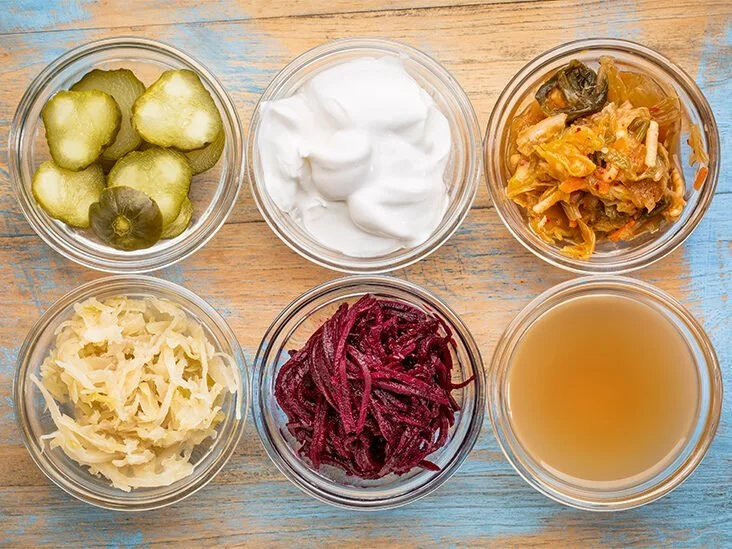
If you don’t like yogurt, you don’t have to force it down for the sake of your gut. You can get probiotics from kefir, kimchi, sauerkraut, miso, tempeh, natto, brine-cured pickles and kombucha. All of them except kefir are dairy-free, and kefir also comes in water and coconut versions. Each one has its own flavor and texture, so even if yogurt has never been your thing, there’s a good chance one of these will be. If you’d like help choosing what suits your gut, you can learn more about my nutrition coaching for gut health.
What are probiotics?
Probiotics are live bacteria found in fermented foods and drinks, such as kefir, kimchi and kombucha, as well as yogurt. The most common belong to the Bifidobacterium and Lactobacillus groups. Eating them regularly helps keep the balance between the good and less helpful bacteria in your gut.
These good bacteria live along the gut lining, where they help defend it against harmful bacteria and viruses and support the absorption of nutrients from food. Some people take probiotic supplements, while others prefer to get them from food.
Fermented foods and probiotic foods overlap a lot, but they aren’t always the same thing. Some fermented foods, like vinegar pickles and pasteurized sauerkraut, no longer contain live cultures by the time they reach your plate. That’s why the details below matter when you’re choosing what to buy.
What the research says about probiotic foods
Fermented foods have been studied more closely in recent years, and the early findings are encouraging. In a Stanford trial, adults who ate about six servings of fermented foods a day for 10 weeks had more diverse gut bacteria and lower markers of inflammation. That’s encouraging if you’d rather get your probiotics from food than from a pill.
Still, research on probiotics is still developing, and benefits depend on the strain and the person. What helps one person’s digestion may do very little for someone else’s. That’s why probiotic foods are best seen as one part of a varied, nourishing diet, rather than a fix for any single problem.
8 probiotic foods to eat instead of yogurt
Yogurt is one of the best-known sources of probiotics, but it isn’t for everyone. Maybe you don’t like the taste or texture, maybe you avoid dairy, or maybe you simply want more variety. These foods offer live cultures in very different forms, from drinks to spreads to side dishes. If you avoid dairy, seven of the eight are dairy-free, and the eighth, kefir, has non-dairy versions.
There’s no single best probiotic food. Different foods carry different bacteria, so eating a variety of them matters more than eating a lot of any one.
Kefir
Dairy-free? Not usually, but water and coconut kefir are. Kefir is a tart, drinkable cousin of yogurt. Where yogurt is thick and creamy, kefir is thin enough to drink, and it’s more tart thanks to the fermentation process and the yeast it contains. It’s usually made with dairy milk, but you can also find versions made with water, coconut water, coconut milk or rice milk. Kefir generally contains a wider range of bacterial strains than yogurt. It comes in fruit and vegetable flavors, or you can add your own, like cinnamon, vanilla or pumpkin spice, and it makes an excellent base for smoothies.
Kimchi
Dairy-free? Yes. Kimchi is a traditional Korean side dish made from fermented vegetables, usually cabbage and radish, flavored with ginger, chili and other spices and herbs. It tastes amazing, and it adds variety to the good bacteria in your gut.
If you’re sensing a fermented food theme, you’re not wrong. Fermentation relies on live microorganisms to change the food, which is why so many fermented foods are also probiotic foods. Kimchi is often served on its own or with rice or noodles, and it’s delicious in scrambled eggs or on top of potatoes. You’ll find it at most grocery stores and Asian markets.
If you have a histamine intolerance, fermented foods may not agree with you at first, so introduce them slowly.
Miso
Dairy-free? Yes. Miso is a traditional Japanese paste made from soybeans fermented with rice or barley and salt. It has a strong, salty flavor, and a little goes a long way. Use it in a dipping sauce, spread it thinly on toast, or add it to marinades for fish, meat and vegetables. Cooking can kill live cultures, so stir miso in at the end rather than boiling it.
Pickles
Dairy-free? Yes. Pickles can be a great source of probiotics, but there’s a catch: it can’t be just any pickle. The way they’re brined makes all the difference.
When pickles are made with a vinegar brine, the growth of good bacteria is halted. Pickles fermented in a saltwater brine keep their live cultures, because salt water doesn’t stop the bacteria from growing. Look for brands brined in water and salt rather than vinegar. Fermented pickles make an easy snack or a crunchy side with lunch.
Kombucha
Dairy-free? Yes. Kombucha is fermented black or green tea, often with natural flavorings, so alongside its probiotics, you also get some of the benefits of tea. It’s naturally a little fizzy, which is why many people enjoy it in place of soda.
Some brands and blends are high in added sugar, though, and too much added sugar isn’t good for your gut or your overall health. Check the label and choose one that’s low in added sugar.
Sauerkraut
Dairy-free? Yes. Sauerkraut is fermented cabbage, and it can be an acquired taste. Try it on a hot dog, mixed into a salad, or alongside your usual side vegetables.
Choose raw or unpasteurized sauerkraut. It contains more probiotics than standard shelf versions, which lose much of their bacteria during pasteurization.
Tempeh
Dairy-free? Yes. Tempeh is a cake made from fermented soybeans, with a firmer texture than tofu. It’s a popular meat substitute, whether you use it as a veggie burger patty or crumble it into pasta sauce. Its mild, nutty flavor soaks up marinades well. Tempeh often comes precooked and ready to eat, though some brands need cooking. Keep in mind that cooking can kill live cultures, so heated tempeh will carry fewer of them.
Natto
Dairy-free? Yes. Natto is a traditional Japanese dish made from fermented soybeans. It has a sticky, stringy texture and a strong flavor that many people need a few tries to warm up to. It’s traditionally eaten over rice, often with mustard and soy sauce. Beyond its probiotics, it’s one of the richest food sources of vitamin K2, which plays a role in bone health.
How to choose and add probiotic foods
When you’re shopping, look for “live and active cultures” or “unpasteurized” on the label. Heat and pasteurization kill the bacteria, so these words tell you the cultures are still alive.
If fermented foods are new to you, start slowly. A small amount at first gives your digestion time to adjust, and adding a lot at once can leave you feeling gassy or bloated. Variety helps here, too. A few probiotic foods you genuinely like are much easier to keep in your week than one you have to force down.
Boost your fiber intake
Fiber feeds the good bacteria in your gut. It acts as a prebiotic, which means it provides the fuel probiotics need to grow in number and variety. Vegetables, fruit, whole grains, root vegetables and legumes are all good sources, and these easy ways to add more fiber make it simpler to eat more of them.
What about supplements?
Probiotic supplements vary widely in their strains and amounts, and the right one depends on why you’re taking it. If you’re considering one, it’s worth asking a dietitian which, if any, makes sense for you.
Probiotics and IBS
If you have IBS, you may have heard that probiotics can help. The evidence is more mixed than that. The American College of Gastroenterology doesn’t recommend probiotics to treat overall IBS symptoms, so if you have IBS, it’s worth working out what helps you with a dietitian.
IBS can also be affected by stress through the gut-brain axis, the two-way connection between your gut and your brain. That’s part of why the foods that work for one person with IBS may not work for another.
Finding probiotic foods you enjoy
Not liking yogurt doesn’t mean missing out on probiotics. Whether it’s kimchi with dinner or kefir in your morning smoothie, there’s room to find foods you actually enjoy and that your gut agrees with.
→ Explore dietitian-led nutrition coaching
Sources
Wastyk HC, Fragiadakis GK, Perelman D, et al. Gut-microbiota-targeted diets modulate human immune status. Cell. 2021.
Lacy BE, Pimentel M, Brenner DM, et al. ACG Clinical Guideline: Management of Irritable Bowel Syndrome. American Journal of Gastroenterology. 2021.
National Center for Complementary and Integrative Health (NIH). Probiotics: Usefulness and Safety.